
In precision motion systems, linear movement is not always enough. Optical instruments, measuring equipment, semiconductor machinery and precision positioning systems often require accurate angular adjustment around a defined center of rotation.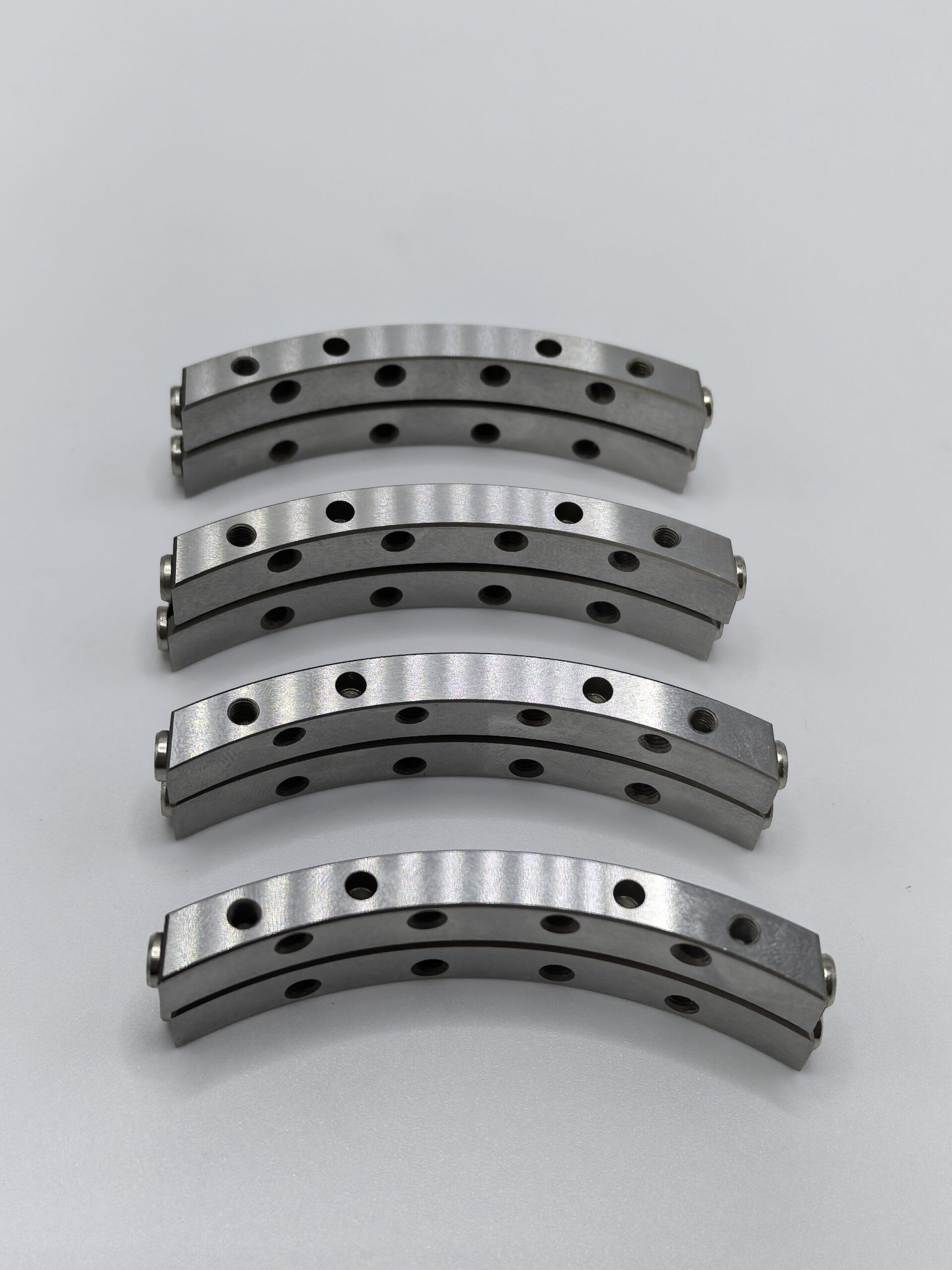
A curved cross roller guide, also known as a cross roller arc guide, curved crossed roller guide, or Gonio Way, is designed for this type of high-precision angular motion.
By combining precision rollers, crossed roller arrangement and accurately machined curved raceways, the guide provides smooth movement, high rigidity and precise angular positioning within a compact mechanical structure.
What Is a Curved Cross Roller Guide?
A curved cross roller guide is a precision motion component designed to guide a moving table or stage along an arc rather than along a straight line.
Unlike a conventional linear guide, which moves a load along a straight axis, an arc guide allows the moving component to tilt or rotate through a controlled angular range.
The rolling elements are arranged alternately at approximately 90 degrees to each other. This crossed arrangement allows the rollers to support forces from different directions while maintaining high rigidity.
The principle is closely related to conventional crossed roller guides, where precision rollers are orthogonally arranged along V-shaped raceways to provide a highly rigid and smooth rolling mechanism.
For curved applications, the raceway geometry is formed around a specific radius so that the table follows a controlled circular path.
How Does a Curved Cross Roller Guide Work?
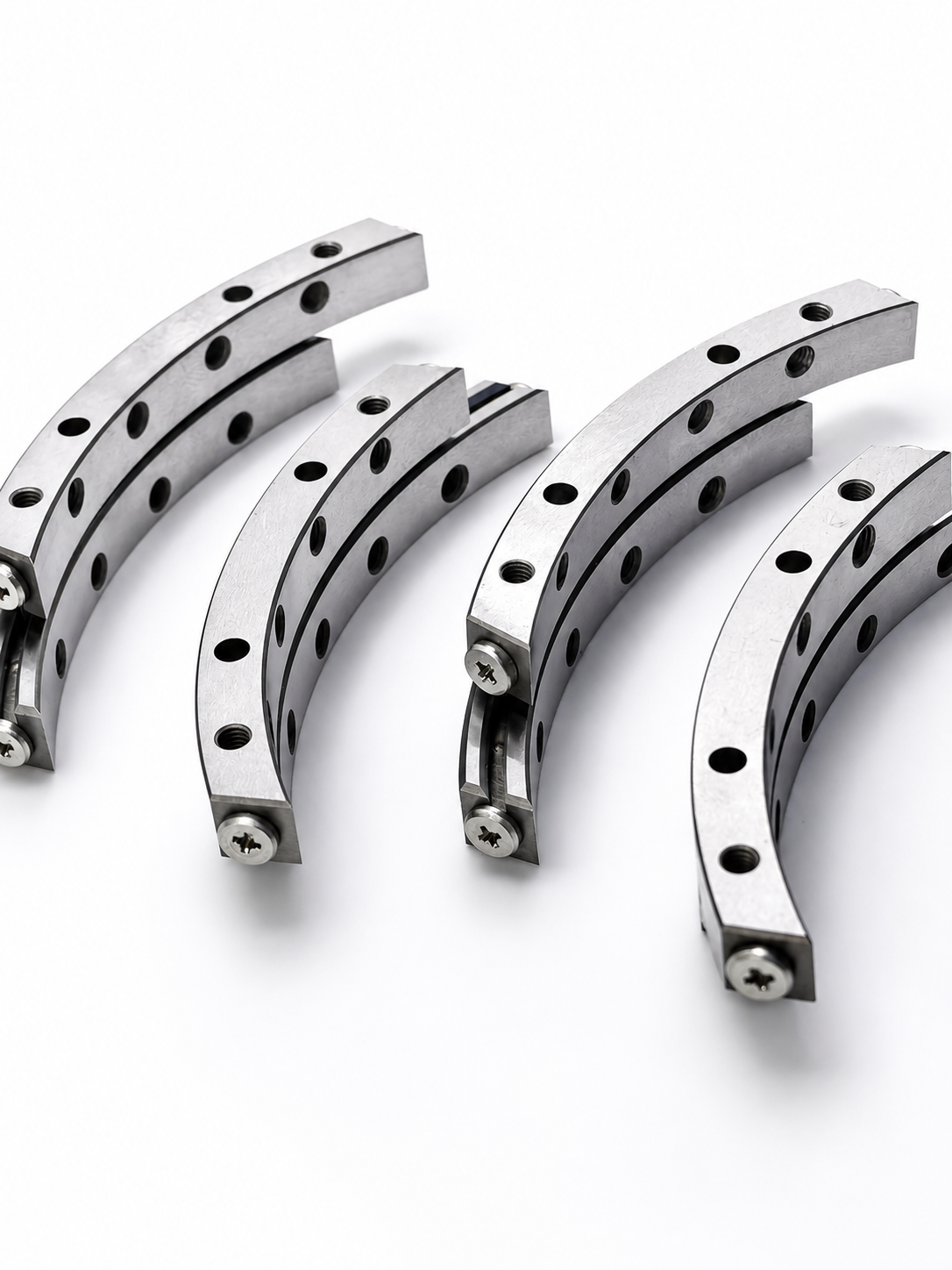
The guide normally consists of precision-machined guide rails, crossed cylindrical rollers and a roller cage or retainer.
As the stage moves, the rollers travel between the precision raceways while maintaining rolling contact.
Because adjacent rollers are arranged in alternating directions, the load is distributed through multiple contact points rather than concentrated in only one direction.
This structure provides several important characteristics:
- High rigidity
- High positioning accuracy
- Smooth rolling motion
- Low friction
- Compact construction
- Preload capability
- Reduced clearance
- Stable angular movement
When suitable preload is applied, mechanical clearance can be minimized or eliminated. This is particularly important in applications where small positioning errors can affect measurement, imaging or alignment accuracy.
Curved Cross Roller Guide vs. Linear Cross Roller Guide
Although the two products use similar crossed roller principles, their motion paths are different.
A linear cross roller guide produces straight-line motion.
A curved cross roller guide produces controlled motion along a defined radius.
The curved design is therefore especially suitable when a machine needs to adjust an angle while maintaining a predictable center of rotation.
For example, a precision optical stage may require an optical element to tilt by a small angle without significantly shifting the working point. In this type of mechanism, an arc guide can simplify the structure compared with combining several independent linear and rotary mechanisms.
Key Advantages of Curved Cross Roller Guides
1. High Rigidity
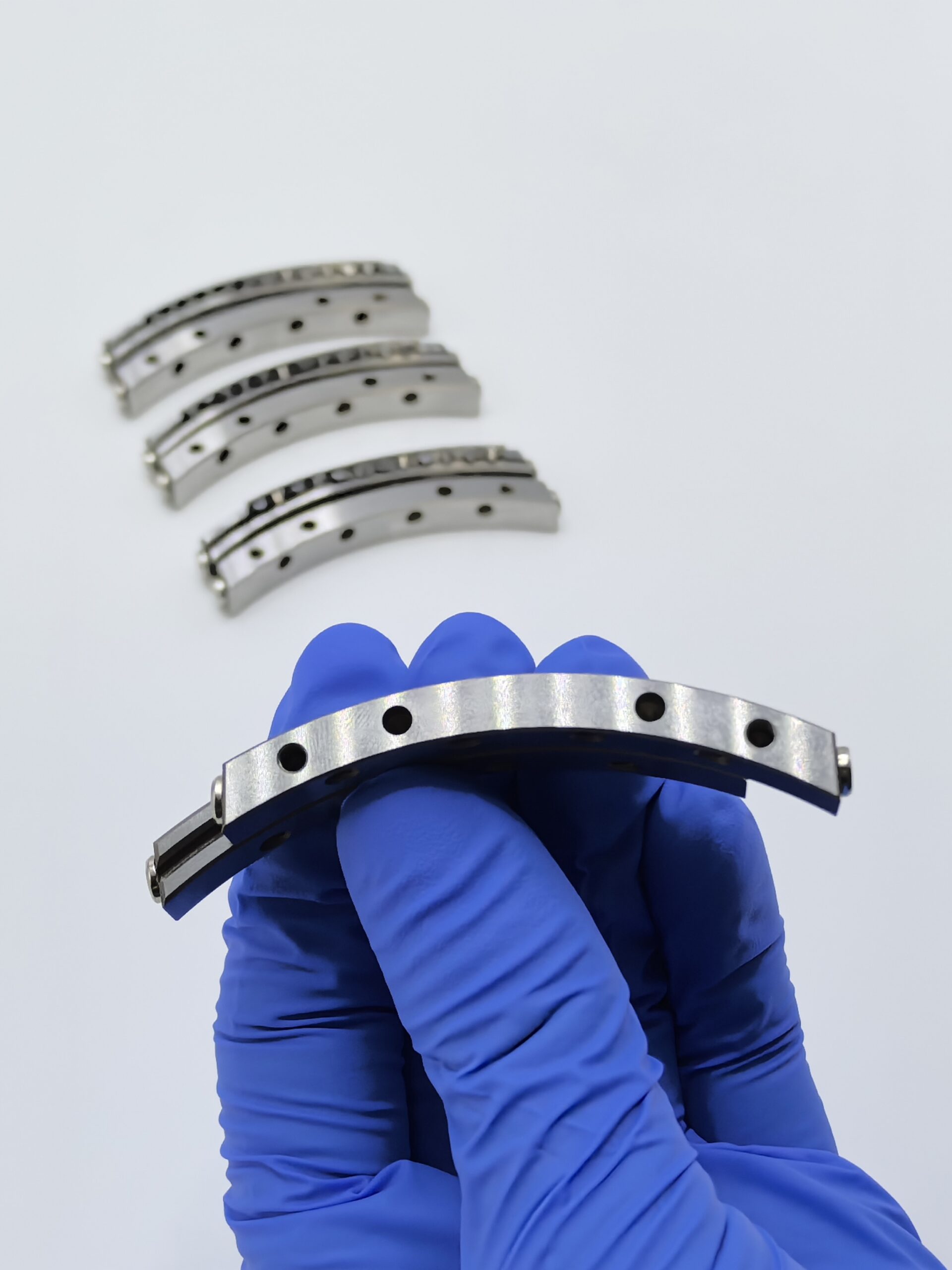
Precision cylindrical rollers provide line contact with the raceway, allowing the guide to achieve high stiffness in a compact structure.
High rigidity is particularly important when the stage is exposed to changing loads, external forces or vibration.
For precision equipment, reduced structural deformation helps maintain more stable positioning.
2. Smooth and Low-Friction Motion
Rolling contact significantly reduces sliding friction.
A properly designed crossed roller mechanism can provide smooth movement with relatively small differences between starting and running resistance.
This characteristic is valuable in applications requiring fine manual adjustment, micro-positioning or controlled low-speed motion.
3. High Angular Positioning Accuracy
The curved raceway controls the movement around a designed radius.
This makes the mechanism suitable for fine angular positioning and alignment systems where the movement trajectory must remain highly repeatable.
4. Preload and Low Clearance
Cross roller guides can be configured with preload to reduce mechanical clearance.
A properly preloaded guide provides a more rigid motion system and helps minimize unwanted movement when the direction of motion changes.
This is particularly useful in measuring equipment, optical stages and other precision mechanisms.
5. Compact Mechanical Design
A curved guide can integrate angular motion directly into the guide mechanism.
In suitable applications, this can reduce the need for additional rotary joints, complex linkages or multiple positioning axes.
The result can be a more compact and mechanically efficient positioning system.
Typical Applications
Curved cross roller guides are primarily used in equipment where precision angular adjustment, rigidity and smooth motion are required.
Optical Stages and Optical Measuring Equipment
Optical systems often require lenses, mirrors, sensors or samples to be aligned at very precise angles.
A curved crossed roller guide can provide controlled tilt adjustment while helping maintain the designed rotational geometry.
Typical applications include:
- Optical stages
- Laser alignment equipment
- Optical measuring machines
- Microscopy equipment
- Precision inspection systems
Semiconductor Manufacturing and Inspection Equipment
Semiconductor equipment requires highly controlled mechanical positioning.
Curved cross roller guides can be incorporated into alignment, inspection and positioning mechanisms where small angular adjustments are necessary.
Their rigidity and smooth motion make them suitable for precision mechanical assemblies used in semiconductor manufacturing and inspection systems.
Precision Measuring Instruments
Measurement accuracy depends heavily on mechanical stability.
In coordinate measuring, optical measuring and precision inspection equipment, unwanted clearance or deformation may influence measurement results.
A preloaded curved cross roller guide provides a rigid mechanical platform for precise angular adjustment.
Robotics and Precision Handling Mechanisms
Robotic and handling equipment sometimes requires compact angular correction rather than continuous rotary motion.
Curved guides can be used for controlled tilting, alignment and orientation adjustment in precision automation mechanisms.
Medical and Imaging Equipment
Precision imaging and scanning equipment may require controlled movement of sensors, detectors or mechanical stages.
High rigidity and repeatable angular motion make crossed roller guide mechanisms suitable for applications where stable positioning is important.
Curved Cross Roller Guide vs. Rotary Bearing
A rotary bearing is designed primarily for continuous rotational movement around a shaft or axis.
A curved cross roller guide is different.
It is generally used for limited angular travel and precision positioning along a predetermined arc.
For applications requiring only a small angular adjustment, an arc guide may provide a simpler and more compact solution because the required movement is integrated directly into the guide structure.
The correct choice depends on factors such as:
- Required angular travel
- Center of rotation
- Load direction
- Rigidity
- Positioning accuracy
- Installation space
- Required preload
What Should Engineers Consider When Selecting an Arc Guide?
Selecting the correct guide requires more than simply choosing a rail size.
Several parameters should be evaluated during the design stage.
Radius of Curvature
The guide radius determines the trajectory and rotational center of the stage.
It should therefore be matched to the geometry of the machine or positioning mechanism.
Required Angular Stroke
The required tilt or angular travel determines the necessary guide length and available movement range.
Load and Moment
The guide must support not only the applied load but also the moments generated by the position of the load relative to the guide.
Rigidity
Applications involving optical alignment, semiconductor inspection or high-precision measurement generally require a more rigid structure than conventional positioning systems.
Preload
Appropriate preload can reduce clearance and improve system rigidity.
However, preload should be selected according to the required motion resistance, accuracy and load conditions.
Mounting Accuracy
Even a precision guide cannot achieve its intended performance if the mounting surfaces are inaccurate.
Flatness, parallelism, installation geometry and assembly accuracy should therefore be considered during machine design and installation.
Why Crossed Rollers Are Used in Precision Guide Systems
The crossed roller arrangement is widely used in precision motion systems because adjacent rollers support loads in alternating directions.
In conventional cross roller guides, precision rollers are arranged orthogonally along V-shaped raceways. When correctly assembled and preloaded, this arrangement provides a clearance-free, highly rigid and smooth guiding mechanism.
The same basic principle makes crossed roller technology suitable for precision arc-motion applications.
Curved Cross Roller Guide Solutions from ZOTIK
ZOTIK focuses on precision linear motion and crossed roller guide solutions for industrial equipment.
Our product range includes:
- Crossed roller guides
- Curved cross roller guides
- Cross roller slide solutions
- Roller cages and guide components
- Precision linear motion components
Curved cross roller guides are suitable for applications requiring high rigidity, smooth motion and accurate angular positioning.
For equipment designers and purchasing teams, guide selection can be evaluated according to application requirements including installation dimensions, radius, angular travel, load, preload and positioning requirements.
Need a Curved Cross Roller Guide for Your Application?
If you are developing optical equipment, measuring instruments, semiconductor machinery, precision stages or automation equipment and require a compact precision angular guide mechanism, ZOTIK can help evaluate the appropriate crossed roller guide solution.
Contact us with your application requirements, including:
- Required guide dimensions
- Radius of curvature
- Angular travel
- Load conditions
- Installation space
- Required precision
- Preload requirements
Our team can help you evaluate a suitable curved cross roller guide for your precision motion system.