
Crossed Roller Guides vs. Crossed Ball Guides: Load, Wear & Precision
Introduction
In precision linear motion systems, crossed roller guides and crossed ball guides are widely used in machine tools, automation equipment, measuring instruments, and other applications requiring accurate and stable movement.
Although both guide systems are designed to provide precise linear motion, their rolling elements create different contact conditions, which influence load capacity, rigidity, motion stability, and long-term performance.
Crossed roller guides use cylindrical rollers arranged in alternating directions, while crossed ball guides use spherical rolling elements. The fundamental difference between these two structures is the contact condition between the rolling elements and the raceways.
In many demanding applications, crossed roller guides provide advantages in load capacity and rigidity because their contact changes from point contact to line contact.
However, selecting a suitable guide is not simply a matter of choosing rollers instead of balls. The actual performance of a linear guide depends on its structural design, material quality, manufacturing precision, lubrication, and overall engineering standards.
This article explores the differences between crossed roller guides and crossed ball guides, examines common wear problems, and discusses why manufacturing quality is essential for long-term precision.
1. Crossed Roller Guides vs. Crossed Ball Guides: Understanding the Contact Difference
The most fundamental difference between crossed roller guides and crossed ball guides lies in the contact geometry of their rolling elements.
Crossed Ball Guides: Point Contact
Crossed ball guides use spherical balls as rolling elements.
Under idealized conditions, the contact between a ball and a raceway is concentrated in a small area, commonly described as point contact.
This structure offers several advantages, including smooth movement, compact design, and suitability for precision applications where the required load and rigidity are within the guide’s design limits.
However, under comparable design conditions, the concentrated contact area can result in higher local contact stress when the applied load increases.
Crossed Roller Guides: Line Contact
Crossed roller guides use cylindrical rollers arranged in alternating directions.
Compared with spherical balls, cylindrical rollers create an elongated contact area along the rolling direction, commonly described as line contact.
This larger effective contact area can help distribute loads more effectively and reduce contact stress under comparable conditions.
As a result, crossed roller guides are often selected for applications requiring:
- Higher load capacity
- Greater rigidity
- Improved resistance to deformation
- Stable positioning under demanding operating conditions
- High precision in short-stroke linear motion
The actual load capacity and rigidity depend on roller dimensions, raceway geometry, preload, material properties, and the overall guide design.
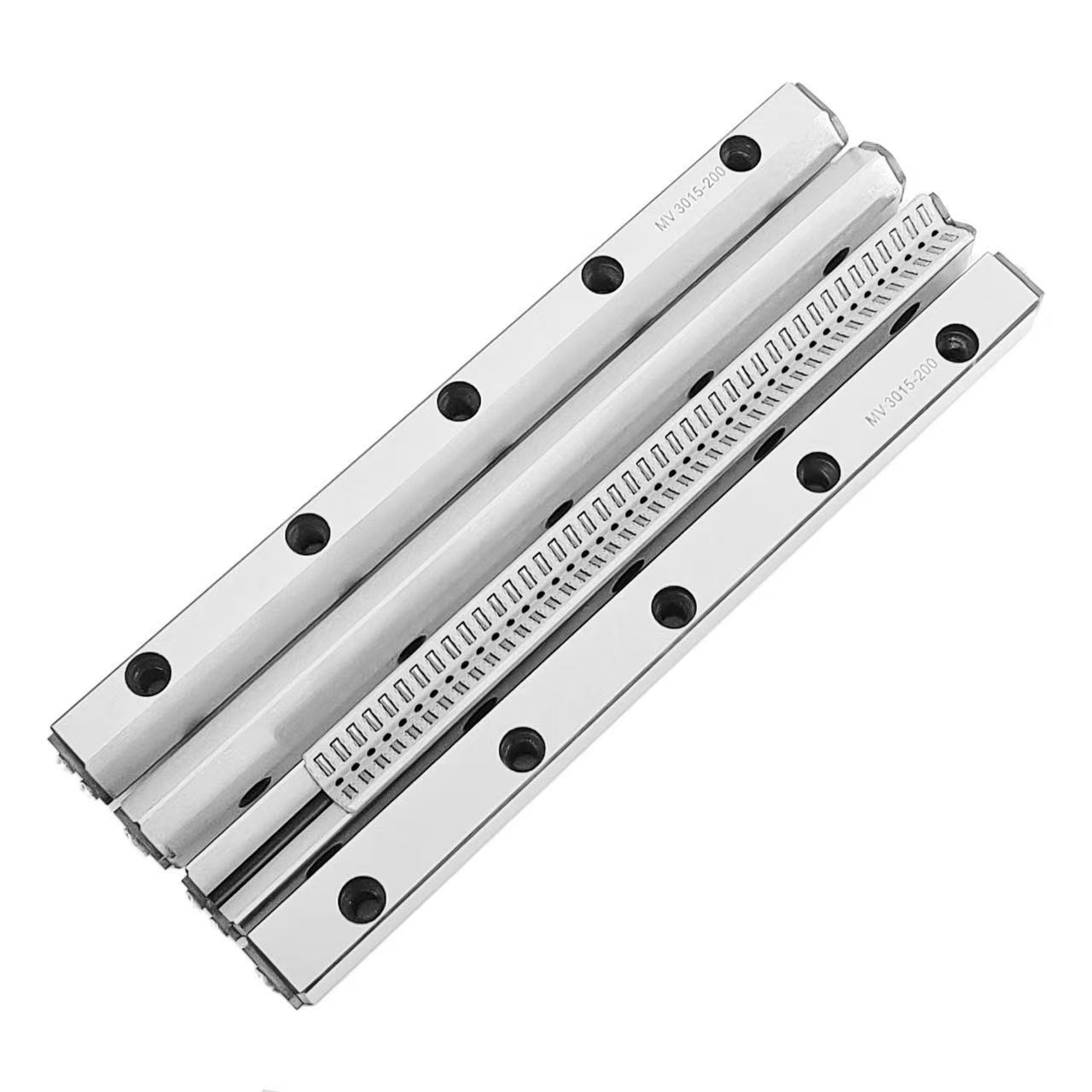
2. Why Are Crossed Roller Guides Used in Heavy-Duty Machinery?
Crossed roller guides are commonly used in applications where load capacity, rigidity, and positioning stability are particularly important.
Typical applications include:
- Precision grinding machines
- Injection molding machines
- CNC machine tools
- Heavy-duty industrial equipment
- Customized machine tools
- Precision inspection and measuring equipment
- Specialized automation machinery
In these applications, linear motion components may be exposed to considerable loads, repeated movement, vibration, and demanding operating conditions.
A guide system must therefore do more than provide smooth movement. It must maintain structural stability and precision throughout its intended service life.
For equipment manufacturers, selecting an appropriate crossed roller guide can help improve the stability of the machine’s motion system and support reliable long-term operation.
However, a guide’s performance cannot be determined by its structure alone. The quality of its manufacturing process is equally important.
3. A Common Problem: Guide Wear and Loss of Precision
As machinery operates over time, linear guides may experience wear due to repeated movement, applied loads, lubrication conditions, contamination, and other operating factors.
When a guide is exposed to heavy loads or demanding operating conditions for extended periods, wear may gradually develop on its raceways and rolling elements.
Depending on the severity and location of the wear, the system may experience:
- Increased friction or resistance during movement
- Reduced motion smoothness
- Changes in preload
- Increased clearance or backlash
- Positioning errors
- Reduced repeatability
- Progressive loss of precision
For precision machinery, these changes can become particularly important.
A small deviation in the linear motion system may affect the machining accuracy, positioning consistency, or overall performance of the equipment.
The photograph illustrates a potential wear condition. The exact cause of wear should not be determined from appearance alone.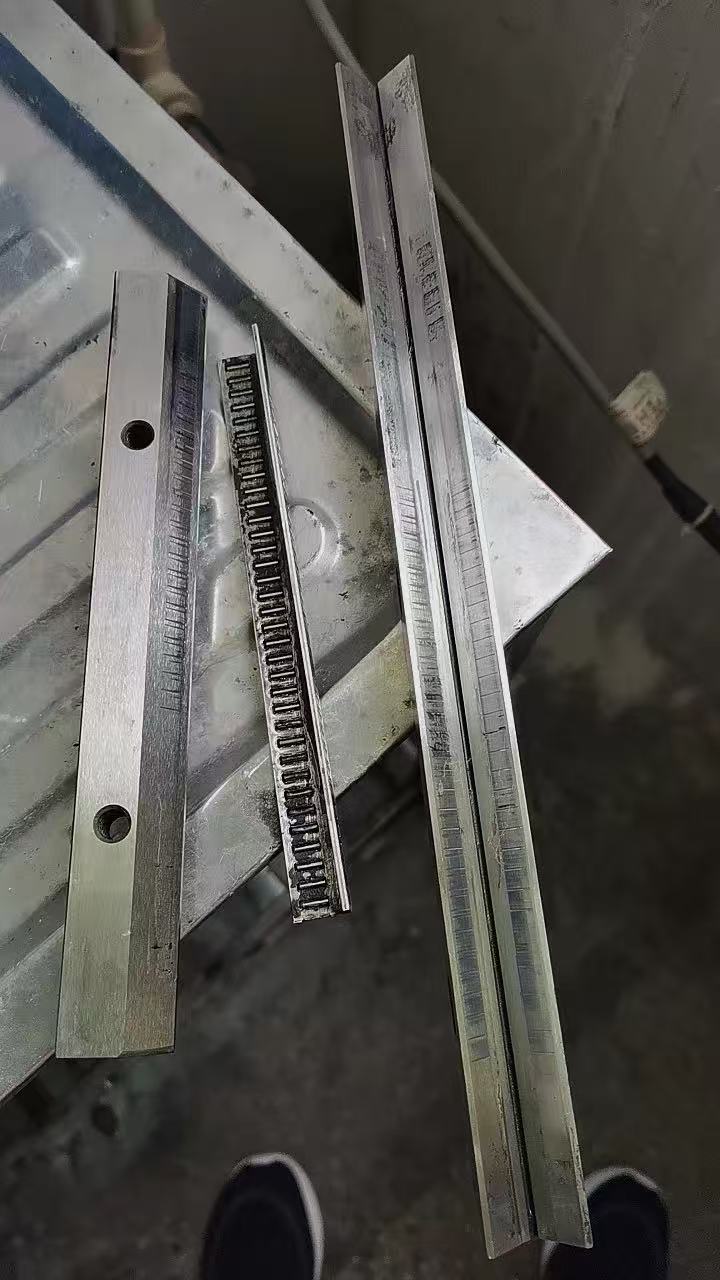
4. Why Do Some Linear Guides Experience Premature Wear?
In the linear motion industry, products with similar external dimensions or structural designs may have significantly different performance and service life.
This difference is often related to manufacturing quality and process control.
4.1 Material Quality
The quality and consistency of the steel used in guide rails and rolling elements are fundamental to performance.
Material selection should consider hardness requirements, wear resistance, fatigue resistance, and the intended operating conditions.
Inadequate material quality may reduce the guide’s ability to withstand repeated loading.
4.2 Heat Treatment
Heat treatment is a critical manufacturing process for precision linear guides.
An appropriate heat treatment process helps achieve the required hardness and mechanical properties while maintaining dimensional stability.
If heat treatment is insufficient or poorly controlled, the raceways may not provide the expected wear resistance and fatigue performance.
However, achieving high hardness alone is not enough. The material must also maintain suitable toughness and structural integrity.
4.3 Raceway Grinding and Manufacturing Precision
Precision grinding determines the geometry, surface quality, and dimensional consistency of guide raceways.
Poor surface finish, dimensional deviations, or inconsistent manufacturing processes may affect contact conditions between the rolling elements and raceways.
These problems can influence friction, load distribution, and motion accuracy.
4.4 Roller and Ball Quality
The rolling elements inside a guide are just as important as the guide rails themselves.
Roller or ball diameter consistency, roundness, surface finish, material quality, and manufacturing precision all contribute to the performance of the complete guide system.
Even if the guide rail is manufactured to a high standard, inconsistent rolling elements may prevent the system from achieving its intended precision.
4.5 Cage and Retainer Quality
The cage or roller retainer helps maintain the arrangement and spacing of the rolling elements.
A properly designed and manufactured cage supports stable movement and helps maintain consistent rolling element positioning.
Poor cage quality, unsuitable clearances, or dimensional inconsistencies may affect the stability of the rolling elements and the overall motion system.
For crossed roller guides, the cage is not simply an accessory. It is an important component of the complete precision motion assembly.
4.6 Lubrication and Operating Conditions
Lubrication plays an essential role in reducing friction and protecting the rolling contact surfaces.
Insufficient lubrication, unsuitable lubricant selection, contamination, excessive loads, and improper installation may accelerate wear.
Even a high-quality guide can experience premature deterioration if it is operated outside its intended conditions.
5. Why the Entire Linear Motion System Must Be Considered
When a crossed roller guide experiences wear or precision loss, replacing only one component may not always solve the underlying problem.
The guide rail, rolling elements, cage, lubrication, installation conditions, and applied loads work together as a complete system.
For example, a high-quality guide rail cannot fully compensate for inaccurate rollers.
Likewise, precision rolling elements cannot deliver their intended performance if the raceways are poorly manufactured or the cage does not maintain stable roller positioning.
This means that high-precision linear motion requires coordinated quality across the entire manufacturing chain.
The key components include:
- Guide rail material and heat treatment
- Raceway geometry and surface finish
- Roller or ball manufacturing precision
- Cage design and dimensional consistency
- Assembly accuracy and preload control
- Lubrication and quality inspection
- Durability and performance testing
Only when these elements are properly coordinated can a guide system achieve reliable performance under demanding conditions.
6. How Can Manufacturers Improve the Reliability of Crossed Roller Guides?
Improving the service life and precision of crossed roller guides requires a systematic approach rather than relying on a single specification.
Step 1: Select Suitable Materials
Choose materials that meet the required hardness, wear resistance, fatigue resistance, and operating conditions.
Material consistency should be verified through appropriate quality control.
Step 2: Improve Heat Treatment Control
Develop stable heat treatment processes and verify the resulting mechanical properties.
The objective is not simply to achieve a high hardness value, but to obtain a balanced combination of hardness, toughness, and dimensional stability.
Step 3: Maintain Raceway Precision
Control grinding accuracy, surface finish, and dimensional consistency.
The raceways should provide reliable contact conditions for the rolling elements.
Step 4: Improve Rolling Element Quality
Ensure that rollers or balls meet the required dimensional and surface quality standards.
Consistent rolling elements help support stable load distribution and smooth movement.
Step 5: Optimize Cage Design
The cage should maintain appropriate roller spacing and support stable movement throughout the operating stroke.
For replacement cage assemblies, compatibility with the existing guide structure and operating conditions is particularly important.
Step 6: Conduct Durability and Performance Testing
Before products are introduced into demanding applications, manufacturers should evaluate their performance through appropriate inspection and testing.
Depending on the application, testing may include:
- Dimensional inspection
- Hardness verification
- Motion smoothness evaluation
- Load testing
- Wear evaluation
- Repeatability testing
- Durability testing under representative operating conditions
Testing should reflect the intended application rather than relying solely on nominal specifications.
7. The Future of China’s Linear Motion Industry: From Quantity to Quality
China’s linear motion industry has developed rapidly, with an increasing number of manufacturers offering crossed roller guides, crossed ball guides, and other precision motion components.
As the market expands, product quality and manufacturing consistency are becoming increasingly important.
For demanding industrial applications, customers are not simply looking for a product with a competitive price.
They also expect:
- Reliable precision
- Consistent manufacturing quality
- Stable performance under load
- Longer service life
- Effective technical support
- Reliable replacement components
- Transparent product specifications
The future development of the industry should therefore focus not only on production volume, but also on manufacturing standards, engineering capabilities, and long-term product reliability.
Moving from a quantity-oriented production model toward a quality-oriented manufacturing model requires continuous investment in materials, heat treatment, precision machining, testing, and technical development.
This is not a challenge for one manufacturer alone.
It is a long-term objective for the entire linear motion supply chain.
8. ZOTIK: Precision Linear Motion Components and Custom Solutions
At ZOTIK / Zhongtuodrive, we focus on crossed roller guides, crossed roller arc guides, replacement cage assemblies, and customized precision motion components.
We understand that the performance of a precision guide depends on the quality and coordination of its individual components.
Our product development and manufacturing approach emphasizes material quality, precision processing, component compatibility, and practical application requirements.
For customers working with existing machinery or customized equipment, selecting the correct guide or replacement cage requires careful consideration of dimensions, operating conditions, load requirements, and compatibility.
We support customers with standard products and customized solutions based on their technical requirements.
If you are experiencing guide wear, unstable motion, or precision loss, it is important to evaluate the complete motion system rather than focusing on one component alone.
Conclusion
Crossed roller guides offer important advantages over crossed ball guides in many applications requiring higher load capacity and rigidity.
Their line-contact structure can support demanding operating conditions, making them suitable for precision machine tools, grinding machines, injection molding equipment, and customized industrial machinery.
However, the performance of a crossed roller guide is determined by more than its structural design.
Material quality, heat treatment, raceway precision, rolling element accuracy, cage quality, lubrication, and durability testing all contribute to the reliability of the complete system.
As the linear motion industry continues to develop, improving manufacturing quality and technical standards will be essential for achieving greater precision, reliability, and service life.
The long-term direction of the industry should be clear: moving from quantity-driven production toward quality-driven manufacturing.
Contact ZOTIK
Looking for crossed roller guides, replacement roller cage assemblies, or customized precision linear motion components?
Send us your drawings, dimensions, product specifications, or application requirements for technical evaluation.
Website: https://zhongtuodrive.com
Email: info@zhongtuodrive.com